
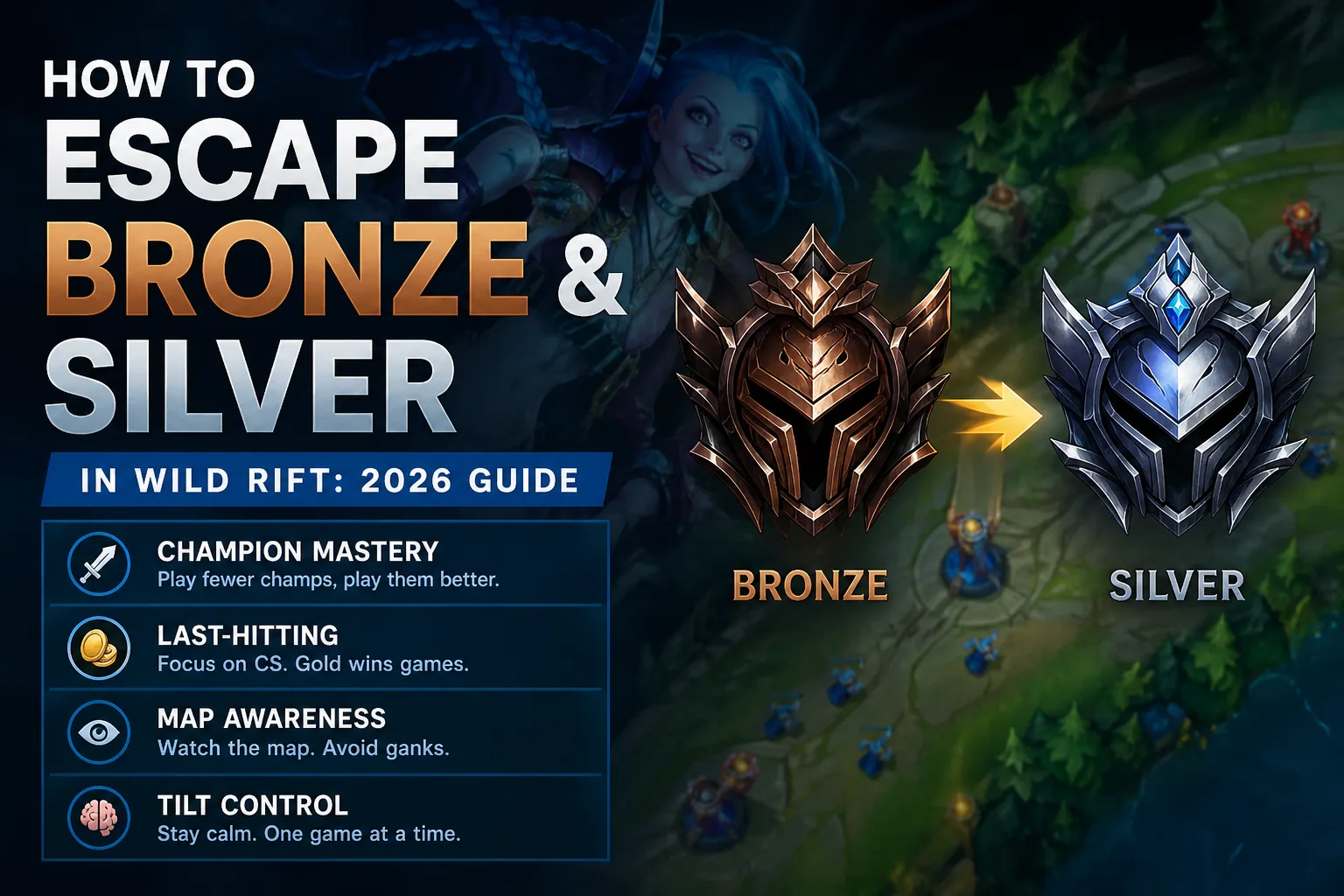
How to Escape Bronze and Silver in Wild Rift: The 2026 Fundamentals Guide
 By Marcus Chen
8 min read
By Marcus Chen
8 min read
- The basics carry harder here than at any other rank: last-hit minions, stop dying for nothing, and look at the minimap. Doing those three things consistently is enough to climb.
- Pick one easy champion and play it until your fingers hurt. Champion swapping is the number one reason players stay in Bronze.
- Stop reading "your team is bad" comments online. Bronze and Silver have the highest individual impact in the game; you can carry almost any match.
- One easy champion mastered to 100 games beats five champions played 20 games each. Mastery is the cheat code at low ranks.
- Last-hitting under tower is the single highest-value mechanic to drill. Most Bronze players miss half their CS; fixing that alone moves you a division.
- Don't trust your team to win for you, but don't blame them when you lose either. Every Bronze and Silver loss has at least one mistake of your own to fix.
Bronze and Silver are not skill problems. They are fundamentals problems. The opponents you face miss CS, walk into ganks, chase kills into towers, and tilt at the first death. Doing the simple things consistently is enough to climb out, and this guide lays out exactly which simple things, in priority order, with no fluff and no galaxy-brain macro you don't need yet.
Why Bronze and Silver Are Different from Higher Ranks
Most climbing guides on YouTube are written by Diamond and Master players solving Diamond and Master problems. The advice doesn't translate. At low ranks, the games are decided by completely different things, and the habits that win matter more than the strategies that look smart on paper.
- Mechanical mistakes are constant. Players miss skill shots, miss CS, and forget summoner spells. Punishing those mistakes is easier than at any rank above.
- Map awareness is near zero. Most opponents will not look at the minimap for thirty seconds at a time. Roams and ganks land more often.
- Games end early or late, rarely in the middle. Either someone snowballs hard in the first ten minutes, or both teams stall to 25-plus minutes and one bad teamfight decides it.
- Tilt is everywhere. One bad fight and half the team starts arguing in chat. Staying calm is a real edge here.
Pick One Easy Champion and Stop Switching
The single biggest mistake Bronze players make: changing champions every game. They lose with one champion, swap to another, watch a YouTube video on a third, and never play any of them long enough to actually learn. Mastery curves are real, and at low ranks they matter more than anywhere else.
The right champion at this rank has three traits:
Switching champions because you lost three games in a row is the biggest tax low-rank players pay. The third loss usually says nothing about the champion and everything about your tilt level.
Last-Hitting: The Mechanic That Carries Bronze
Most Bronze players end a 20-minute game with around 80 to 100 minions killed. Silver players are at 110 to 130. Gold and above are usually 150-plus. That CS gap is hundreds of gold and one to two extra items by the late game; it is the difference between a one-shot and getting one-shot in the first teamfight.
The fix is not complicated; it is just under-practiced:
- Watch the minion's HP bar, not your champion. Your champion is fine. The minion you are about to last-hit needs your full attention for the second before the kill.
- Last-hit under tower with three rules. Caster minions: let the tower hit twice, then last-hit. Melee minions: hit them once before the tower hits, then let the tower do its work. Cannon minions: hit them twice before the tower hits.
- Practice in Co-op vs AI for 15 minutes. Not Practice Tool, not Normals. AI games let you focus on CS without dying and without enemy pressure. A single 15-minute session moves your CS per minute up by 0.5 to 1.0.
Stop Dying for Nothing
Look at your match history. Open a recent loss. Count the deaths that happened with no kill, no objective, and no escape from a worse fight. That number is usually four to seven per game in Bronze. Cutting it to one or two wins games on its own.
The deaths that cost the most LP fall into a handful of patterns. Recognize them and the rate drops fast.
| Death Type | What it looks like | The fix |
|---|---|---|
| Greed death | One more minion. One more auto on the tower. One more chase past the river. | Walk away on full HP. The wave will be there next minute. |
| Tilt death | You died once, came back, and walked straight into the same fight again. | Take a deep breath in fountain. The next minute is for farming, not revenge. |
| Lonely death | You engaged or chased while four teammates were on the other side of the map. | Glance at the minimap before every aggressive move. If you are alone, you fight alone. |
| Vision death | You walked into a bush and got jumped. No ward, no reason to suspect anyone. | Either ward the bush or treat it as enemy territory. You only get one of the two. |
Every death gives the enemy 300-plus gold and 30-plus seconds of free map control. In Bronze, two of those in a row is the game.
A Wild Rift boost from a Sovereign-Ranked pro skips Bronze and Silver in days. Pick your target rank, watch every match live in your dashboard.
Look at the Minimap (Seriously)
If there is one cheat code for Bronze and Silver, it is the minimap. Most opponents at this rank go entire minutes without checking it. Glancing at it once every wave is enough to dodge ninety percent of ganks and spot ninety percent of free roams.
- Look once per wave at minimum. When the new wave meets in the lane is a natural reset point; use it to scan the map for two seconds.
- Note where the enemy jungler was last seen. If the enemy jungler showed up top side at 3 minutes, expect them bot side at 5 minutes. The path is predictable at low ranks.
- If two enemies are missing, you are about to be ganked. No exceptions. Walk to your tower and wait until you see them again.
- If three enemies show on one side of the map, the other side is free. Push the wave, take the tower, take the buff. Free pressure.
Trade Smart, Not Often
Trading is the lane-phase skill that separates Bronze from Silver and Silver from Gold. A trade is any short exchange of damage with the enemy laner. Win them and you get a kill or a back; lose them and you get poked out of lane. Most low-rank trades are bad ones the player did not need to take.
- Trade when their key ability is on cooldown. Watch the enemy's main damage skill. The two seconds after they use it is your free window.
- Trade when the wave is on your side. Minion damage tilts the trade in your favor. Stepping up to trade with five enemy minions hitting you is just dying slowly.
- Trade with a clear exit. If you cannot disengage when the trade goes bad, do not start it. The enemy jungler is always a threat you have not seen yet.
- Win one trade, then back off. Greed turns a winning trade into a death. After a successful trade, reset to safe HP and continue farming.
Vision Even at Low Ranks
Bronze and Silver players treat warding as the support's job. It is not. Every champion in the game gets a free ward trinket and a refresh every 90 seconds, and using it is one of the cheapest LP gains available.
- Ward when you recall, not when you die. A safe ward placed during a recall is worth ten dropped wards in panic.
- Ward the river bush nearest your lane. The single most useful ward for a solo laner. Catches ganks before they happen.
- Ward Drake or Baron pit before the spawn timer. Even one ward turns a 50-50 objective into a 70-30. Place it at 4:30 for a 5:00 spawn, not at 5:01.
- Don't waste wards on areas you'll never use. A ward in your own base is a wasted ward. Vision is for places you plan to fight or walk through.
Stop Reading Chat
Bronze and Silver chat is a tilt machine. One bad fight and someone is calling someone a feeder, blaming the jungler, or threatening to AFK. Reading any of it costs you the next decision.
- Mute on first negative message. Not the third. Not after a warning. The first. Muted teammates play exactly the same; you just play better.
- Don't argue back. Every word you type is a second you are not looking at the map. Even if you are right, you are losing the game right now.
- Disable all chat in solo queue. The setting exists for a reason. Try it for ten games. Most players never turn it back on.
- Pings are enough to communicate. "On my way," "danger," "missing." That is the entire vocabulary you need to win games.
Mistakes That Keep Players in Bronze Forever
A handful of habits look harmless in the moment but compound across hundreds of games. If any of these sound familiar, fixing them is worth more LP than any guide on champion mechanics.
- Switching champion after every loss. Mastery never builds; you are always playing your champion's first 20 games.
- Playing while tilted from the last game. Two losses in a row almost always becomes three. Stop the chain by closing the app.
- Building the same items every game. Wild Rift item paths shift with the matchup. Default builds are starting points, not finishing ones.
- Refusing to play meta champions. "I just play what I like" is fine in Normals. In ranked it is a 5% win-rate tax you don't need.
- Blaming teammates for every loss. Even when they were bad, you were too, and only one of those is in your control.
- Watching streamers play Diamond games. Pro and high-elo content does not transfer. Watch a Bronze-to-Diamond series instead; the lessons match your problems.
None of these are mechanical issues. All of them are habits. Habits are the easiest thing to change once you actually notice them.
A Realistic Climb Plan
The plan that gets the most players out of Bronze and Silver is brutally simple. No 50-page playbooks, no champion mastery spreadsheets. Five things, in order, every session:
- Pick one champion. Same one as last session.
- Play three ranked games with full focus. Phone on do-not-disturb, no streams in the background.
- Mute all chat at game start. Every game.
- After each game, note one thing you did wrong. Just one. Not the team's mistakes, yours.
- If you lose two in a row, stop for the day. The next game is not where you bounce back.
Repeat the cycle for two weeks. Most players who actually follow this climb at least a full division and usually two. The advice that works is rarely the advice that sounds clever.
Sometimes the climb out of Bronze is the climb out of Bronze. Order a Wild Rift boost from a Sovereign-Ranked pro and skip straight to Gold or higher.
Frequently Asked Questions
For a player who actually applies the basics, two to four weeks of focused play. Most players stuck in Bronze for months are not playing badly; they are repeating the same handful of mistakes every game. Fix one mistake and the climb starts immediately.How long does it take to escape Bronze in Wild Rift?
Jungle and mid have the most map influence and can carry weak teammates the hardest. Top is reliable for solo carry potential. ADC depends on having a competent support, which is the lottery in low ranks. Support can climb but requires a duo to be consistent. If unsure, mid is the safest choice.What is the best role for climbing out of Bronze?
Comfort beats meta below Gold. A champion you have 80 games on with a strong build path will outperform a meta pick you've played twice. Pick from the meta tier list only if you have multiple comfort picks already; otherwise stick with what you know.Should I play meta champions or what I am comfortable with?
Three to four ranked games per session is the sweet spot. Beyond that, decision quality drops faster than you can feel and tilt accumulates. Two focused sessions a day with a break between them beats one eight-hour grind every time.How many games per day should I play to climb out of Bronze?
Because the matchmaker also gives you bad opponents. The skill levels balance across both teams. The feeling of "always getting bad teams" is mostly noticing the bad games and forgetting the good ones. Across 50 games, your team and the enemy team have roughly the same total skill; the variable is you.Why do I keep getting bad teammates?
Not at Bronze or Silver. Pro players solve problems you don't have yet, with execution you can't copy yet. Watch a Bronze-to-Diamond climb series instead; the lessons match the problems you are actually facing.Is it worth watching pro Wild Rift to learn?
Close the app. Stand up. Get water. Five minutes away from the screen resets your decision-making in a way that "just one more game" never does. The bad game is already in the past; the next one does not have to be too.How do I stop tilting after a bad game?
Sometimes, because new accounts have wider MMR ranges in placements and can skip divisions on a hot streak. But a new account is also still you, with the same habits. Smurfing only works if the underlying skill matches the target rank; otherwise it just means starting over from Iron.Do new accounts climb faster than ranked-locked old ones?
- Wild Rift Patch Notes, Riot Games.
- Wild Rift Player Support, Riot Games.